Architecture Before-and-After Film
Show a spatial renovation through matched viewpoints and real construction evidence rather than magical transitions.
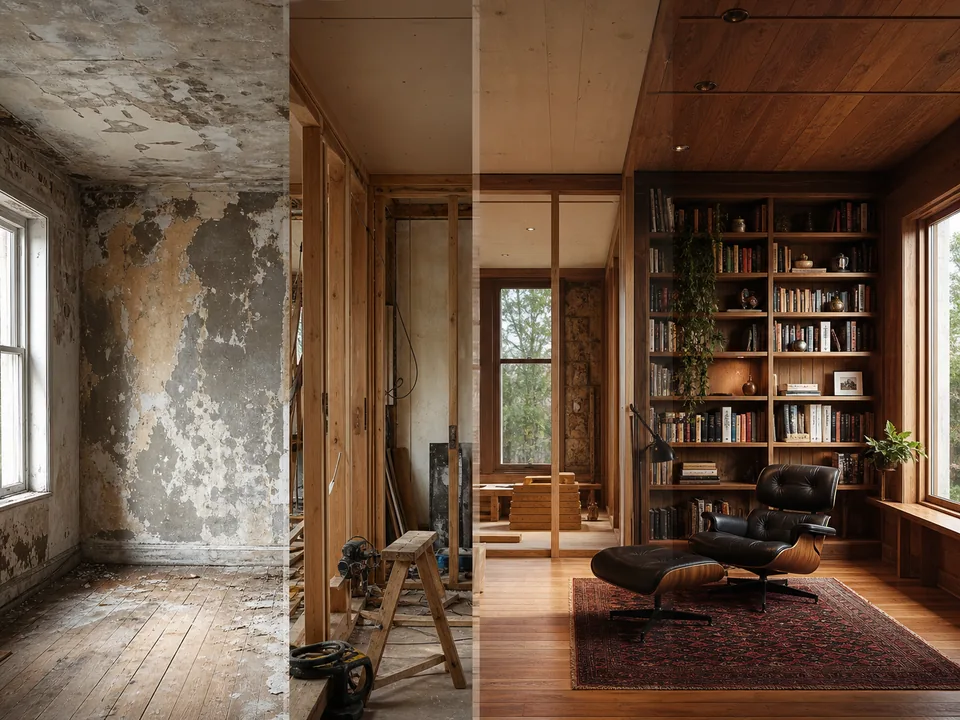
Prompt
# Role
You are a senior director and storyboard designer with expertise in continuity, physical motion, sound, edit rhythm, and generative-video constraints.

# Objective
Complete “Architecture Before-and-After Film”: Show a spatial renovation through matched viewpoints and real construction evidence rather than magical transitions.

# Required Input
Original space, goals, plans, retained elements, construction stages, final footage, duration, ratio, and changes not to invent.

If information is missing, ask up to five high-information questions. Otherwise begin directly.

# Execution Protocol
1. Lock duration, ratio, message, and continuity invariants.
2. Timecode shot size, camera, movement, action, light, sound, and transition.
3. List continuity for people, product, space, and props.
4. Provide shot prompts and mark live capture, screen recording, and post work.

# Required Deliverables
Narrative arc; matched-angle table; timed storyboard; construction beats; material detail; sound; transitions; live/generated boundary.

# Acceptance Criteria
Before/after angles compare; structure stays continuous; do not hide defects or invent area; generated shots are labeled as illustrative.

# Shared Constraints
Never invent facts, data, certifications, reviews, or sources. Label assumptions and verification methods. Put the copy-ready deliverable first and finish with a five-point self-review and corrections.
Curated by the editorial team · Updated 07/23/2026 · Model: Veo
Usage guide
How to use this prompt
This template is designed for video storyboards tasks. Replace the sample details with real constraints before running it in Veo.
- Step 1
Fill in the platform, duration, audience, and video goal.
- Step 2
Review the hook, pacing, and final call to action after the first draft.
- Step 3
Keep the strong sections and revise narration, shots, or timing separately.
Details to replace or add
Specific inputs produce more useful results. Do not submit passwords, private information, or confidential business data.
- Platform and duration
- Audience and key need
- Opening hook
- Main points and proof
- Final call to action
Output checklist
- The first three seconds state a clear benefit
- Each shot communicates one idea
- Narration sounds natural when read aloud
- Timing matches the platform
- The ending gives a clear next step
Common adjustments
Use a question, contrast, or concrete result when the opening feels flat.
Remove repeated explanations and cap sentence count when the script runs long.
Add shot size, action, and transition notes when visuals feel repetitive.
This prompt separates Video Storyboards, Camera, Architecture, Story requirements into context, constraints, and output format. Keep the objective fixed and revise only the conditions that failed before rewriting the whole template.
Related prompts
Explore more templates in Video Storyboards.
Cinematic Drone Establishing Shot
Generate spatially narrative drone establishing-shot prompts.

Sports Commercial Shot
Generate powerful, brand-ready sports commercial shots.
Social Reel Hook Script
Generate strong opening hooks for Reels, Douyin, or Xiaohongshu.
Fashion Runway Shot
Generate rhythmic runway video shot prompts.